
In a tower, hotel, school or labour accommodation, one water tank can serve hundreds of people. When it goes wrong, the result is more than a bad smell in one kitchen. You may face tenant complaints, a building-wide shutdown and awkward questions from inspectors. Commercial water tank cleaning is therefore a compliance and risk task as much as a cleaning job.
This guide is for building owners, facility managers and business operators in Dubai. It covers why large systems fail, what good records look like, how to plan a clean with minimal disruption and how to stop the same problems returning.
Why commercial tanks need a different approach
A villa tank and a commercial system share the same basic risks, but scale changes the work in several ways.
- More tanks in the system. Many buildings have underground tanks feeding roof or intermediate tanks, and all of them need attention.
- More people depend on the supply. Shutdowns must be planned and communicated.
- Harder access. Confined spaces, plant rooms and rooftop locations call for proper risk assessment.
- Uneven demand. Busy floors and empty units use water at very different rates.
- Documentation matters. You need to prove the work was done, and not just arrange it.
What goes wrong in large water tank systems
Sediment building up in underground tanks
The lowest tank in the system collects whatever settles out of the supply. Over time the sludge can be drawn upwards when levels run low or pumps start, which is why tenants sometimes see discoloured water in several units at once.
Stagnation in low-occupancy buildings
Part-empty towers, seasonal businesses and schools during the holidays often hold far more water than they use. Slow turnover gives bacteria more time to grow, and tanks sized for full occupancy are especially prone to it.
Biofilm in pipes and tanks
A clean tank can be recontaminated by the network it feeds if the pipework has been neglected. Where complaints continue after a clean, the distribution pipes may need investigation too.
Damaged tank fittings
Ball valves, level sensors, hatches, vents and overflow pipes all wear out. A failed seal in a plant room can let in dust, insects or even contaminated water from a flooded floor.
Missed schedules and poor handover
When a maintenance contract changes hands, service dates often get lost. A new facility manager may inherit a tank with no reliable history, which is a common reason for overdue cleaning.
Dubai rules and responsibilities
Responsibility sits with the party that controls the property. DEWA’s stated position is that its duty covers water up to the meter, and that tanks and internal networks after the meter are the responsibility of the customer or owner and their maintenance companies.
Published summaries of Dubai Municipality’s 2024 technical guidelines for unbottled drinking water point to these main expectations:
- Tanks emptied, cleaned and disinfected at least twice a year
- Covers intact, fixed in place and inspected at least monthly
- Water samples tested by an EIAC-accredited laboratory after each routine clean and at least every six months
- Records kept and shown to inspectors on request
In jointly owned buildings, tanks are generally treated as common parts, so the work falls to building management. Rules and approved lists are updated from time to time, so check the current Dubai Municipality requirements for your property type. Food businesses, healthcare facilities and hotels may have additional conditions.
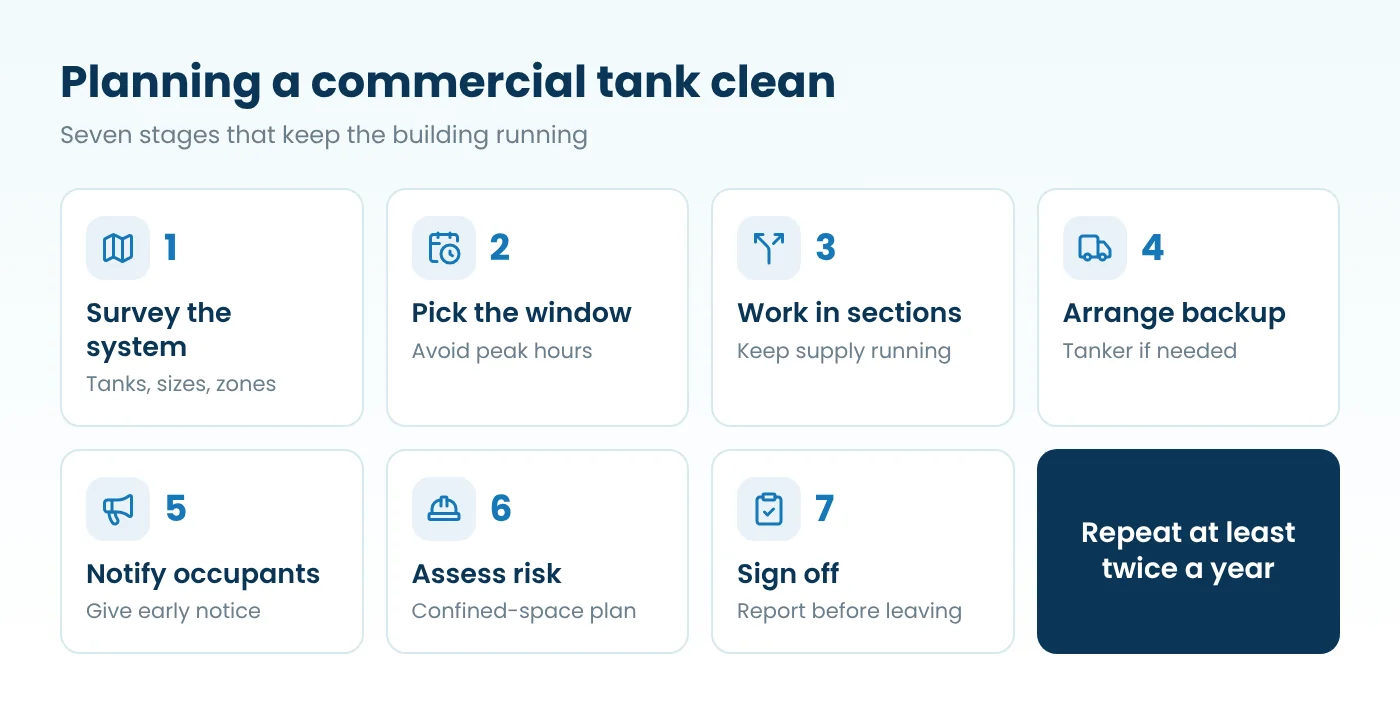
How to plan a commercial tank clean with minimal disruption
The cleaning itself is rarely the difficult part. Keeping the building running around it is what takes planning.
- Survey the system. Map every tank, its size, what it feeds and how it can be isolated.
- Choose the right window. Weekends suit offices, while overnight or mid-morning slots often suit residential towers. Avoid peak periods for restaurants and hotels.
- Clean one compartment at a time. Many large tanks are divided into two sections, which lets you keep part of the supply running.
- Arrange backup water where needed. Plan for tanker delivery if a single-compartment tank must be emptied.
- Notify occupants early. Tell tenants when the water will be off and what to expect afterwards.
- Complete a risk assessment. Confined-space entry calls for trained staff, ventilation, gas checks and a rescue plan.
- Sign off the work. Check the tank before refilling, and collect the report before the contractor leaves.
What your maintenance file should contain
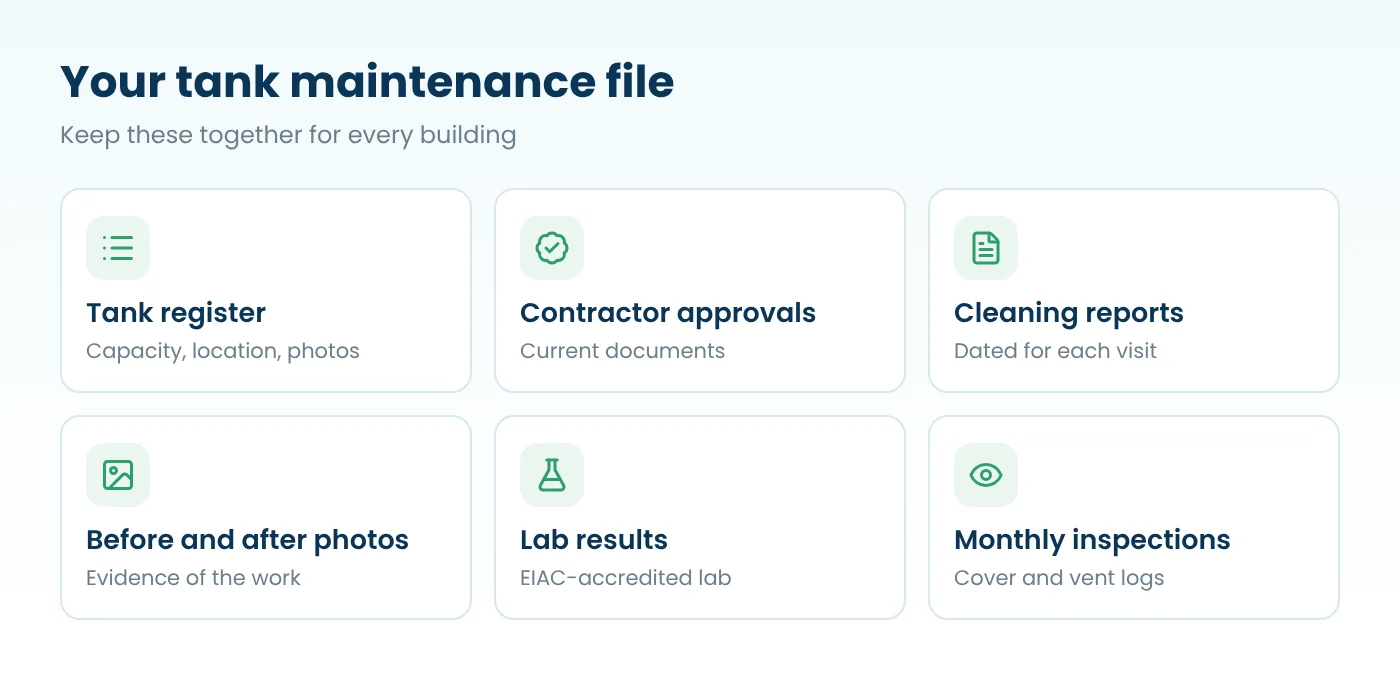
A good file saves time during inspections, tenant queries and contractor changes. Keep these together for each building:
- A list of tanks with capacities, locations and photos
- The approved contractor’s details and approval documents
- Cleaning and disinfection reports with dates
- Before and after photos
- EIAC-accredited laboratory results
- Monthly cover inspection logs
- Records of repairs, complaints and corrective actions
Keep digital copies in a shared folder, so that the history survives a change in manager or contractor.
How to choose a commercial tank cleaning contractor
Price matters, but a low quote can hide missing steps. Ask each company:
- Do you hold current Dubai Municipality approval for this work?
- Have your technicians been trained for confined-space entry?
- Can you show a risk assessment and method statement before the job?
- How will you remove sludge from the site?
- Can you handle out-of-hours work and multiple tanks?
- What exactly is included in your report?
- Do you arrange testing through an accredited lab?
If you want to understand the disinfection stage in more detail, our guide on water tank disinfection in Dubai explains the process step by step.
How much does commercial water tank cleaning cost?
Pricing usually depends on tank capacity, the number of tanks, access, sludge volume, out-of-hours working and testing. Some published Dubai rates run from around AED 950 for smaller tanks to AED 1,500 for tanks of up to 10,000 gallons, but larger or more complex systems are normally quoted after a site visit. Annual contracts covering two cleans can make budgeting easier and reduce the risk of missed visits.
How to prevent repeat contamination
- Fix a twice-yearly schedule. Put dates in the maintenance calendar at the start of the year.
- Inspect monthly. Check covers, vents, overflow screens, leaks and pump rooms.
- Match stored volume to demand. In a low-occupancy building, ask a specialist whether you can reduce the operating level safely.
- Flush unused outlets. Run water through vacant units and rarely used taps on a routine.
- Keep plant rooms clean and dry. Standing water and dirt around a hatch are avoidable risks.
- Replace worn parts promptly. A cheap seal can prevent an expensive incident.
- Log every complaint. Patterns across floors help you trace the cause quickly.
- Filter at the point of use. Offices and restaurants can add filtration for drinking and equipment, while the tanks remain the first line of protection.
Frequently asked questions
How long does commercial water tank cleaning take?
It depends on size and access. A small tank may take a few hours, while a large building with several tanks can take a day or more, often in stages.
Can a tank be cleaned without draining it?
Some companies offer robotic cleaning while water remains in the tank, which can help remove sediment. Dubai’s routine guidance refers to emptying, cleaning and disinfecting, so confirm that any alternative method meets current requirements.
What should we do if tenants report dirty water after a clean?
Sediment may have been disturbed in the pipes. Flush the system, check the outlets and ask the contractor to investigate. Keep a record of what you find.
Do office buildings need laboratory testing?
Published guidance calls for testing after routine cleaning and at least every six months. Testing also gives you evidence that the service worked.
A well-run tank protects your building
Large water systems rarely fail without warning. Clear records, planned shutdowns and a reliable contractor turn tank care into routine work rather than an emergency. To arrange an inspection or a quote for your property, visit our water tank cleaning service page.