
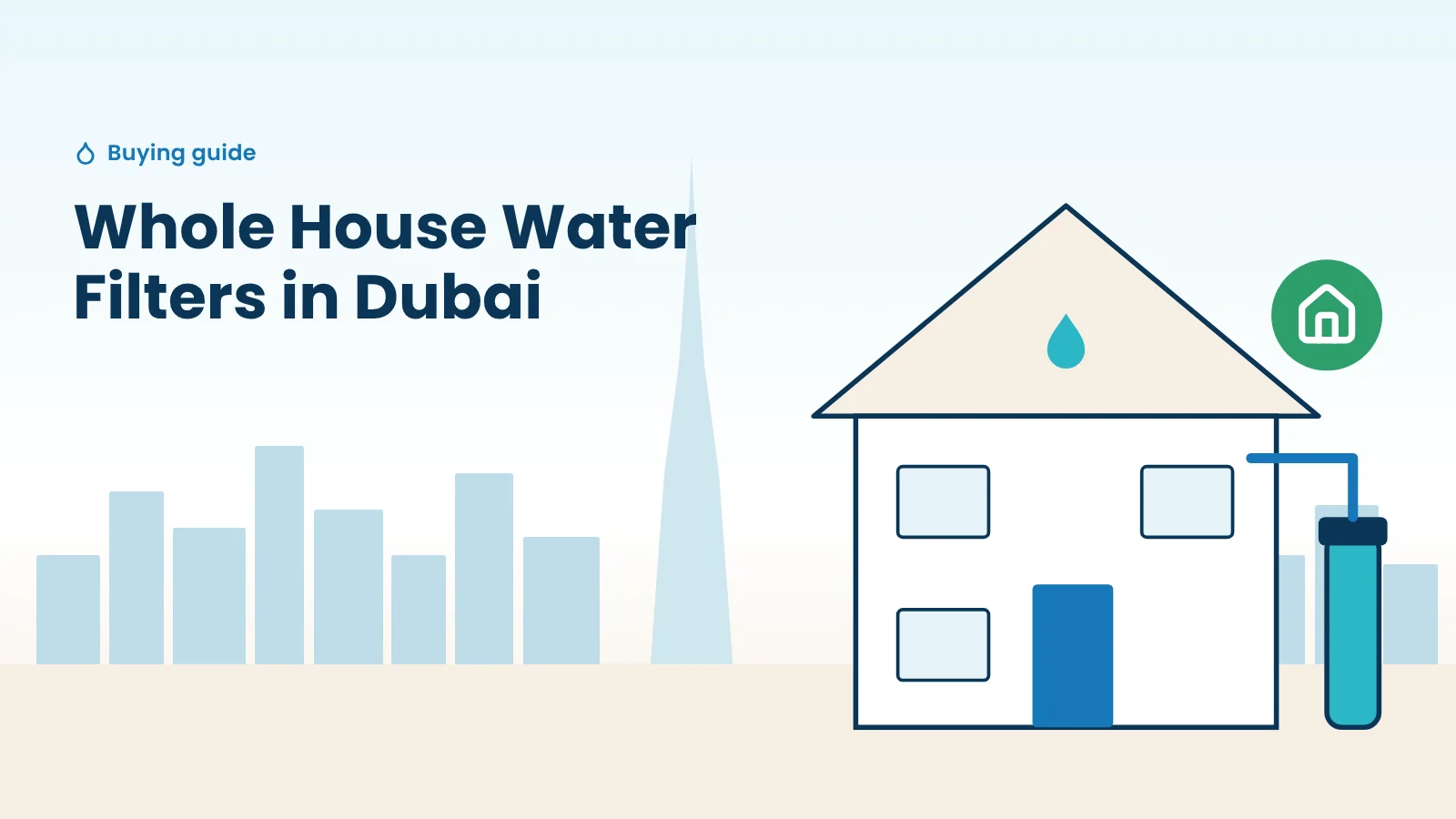
A kitchen purifier only treats the water at one tap. Your showers, washing machine, dishwasher and water heater all use the same supply, and if that supply carries sediment or chlorine, each of them feels it. A whole house water filter treats water where it enters your home, so every outlet receives filtered water.
That said, it is not the right answer for every home, and it will not make up for a neglected tank. This guide looks at the water problems that lead people to consider one, what actually causes them and how to choose a system for a Dubai villa or apartment.
What is a whole house water filter?
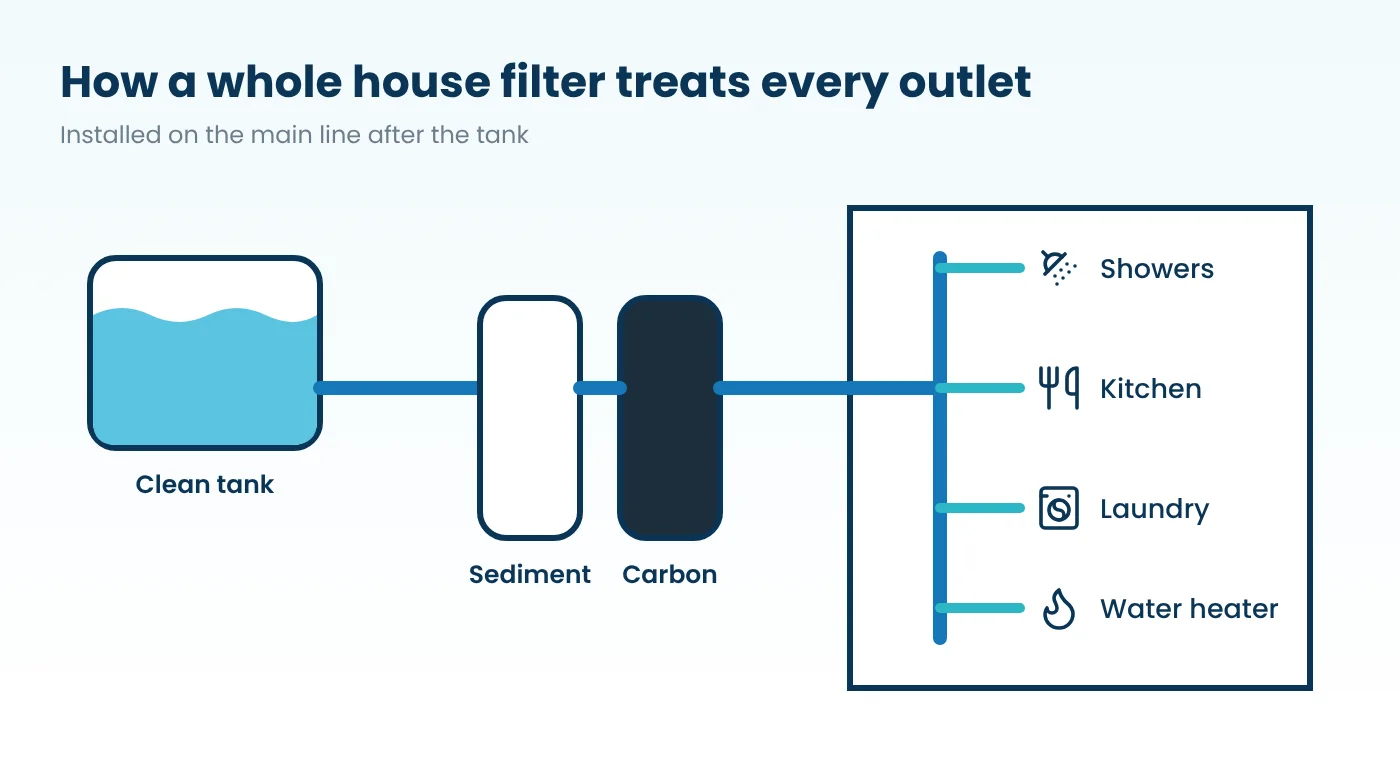
Also known as a point-of-entry system, a whole house filter is installed on the main line, usually after the storage tank or at the point where water enters the property. Typical systems combine two or three stages:
- Sediment stage: captures sand, rust and other particles.
- Carbon stage: reduces chlorine taste and smell.
- Additional media or a softener: treats specific issues such as scale.
An ultraviolet stage can be added for microbial protection, provided the water reaching it is clear enough for the light to work.
Common household water problems and their causes
Discoloured water or visible particles
Rust from older pipes and sediment from a dirty tank are the most frequent causes. You may find stains in white baths, or brown marks on laundry.
Chlorine smell in the shower
A small amount of residual chlorine is a normal part of keeping water safe in the network, but many people notice it in hot showers. A carbon stage reduces it at every outlet.
White scale on taps and appliances
Scale forms when dissolved minerals are left behind as water heats or evaporates. You will see it on showerheads, glass screens and heating elements. Even small amounts can build up over time, particularly in hot water systems.
Clogged aerators and short appliance life
Particles collect in aerators, valves and washing machine inlets. This reduces flow and causes wear in components that were never designed to act as filters.
Water that smells musty
This usually points to the tank, stagnant pipes or the water heater. A filter cannot fix a dirty tank, so the cause should be investigated first.
Do you need a filter, a softener or a drinking water system?
People often use these terms as if they were interchangeable, but each one does a different job.
| Your goal | Best fit | What it will not do |
|---|---|---|
| Remove rust and sediment | Whole house sediment filter | Reduce dissolved minerals |
| Reduce chlorine at every tap | Whole house carbon filter | Prevent scale |
| Reduce scale | Water softener | Purify water for drinking |
| Purer drinking water | RO system at the kitchen sink | Treat the whole house |
| Microbial barrier | UV sterilizer with pre-filter | Remove sediment or chemicals |
Many homes end up with a combination, usually a whole house system for general use and an RO unit at the kitchen sink for drinking. If scale is your main concern, read our article on the role of water softener systems in Dubai.
Fix the source before you filter
Before you spend money on equipment, work through these checks. They can save you from buying a system you do not need, or from overloading one you do.
- Clean the tank. Have it cleaned and disinfected. A dirty tank can block new cartridges very quickly.
- Check your pipes. Rust that appears only on the hot side may point to the water heater.
- Test the water. A laboratory test or a professional assessment will show what you are dealing with.
- List your priorities. Decide whether you care most about skin and hair comfort, appliance protection or stains.
How to choose a whole house water filter
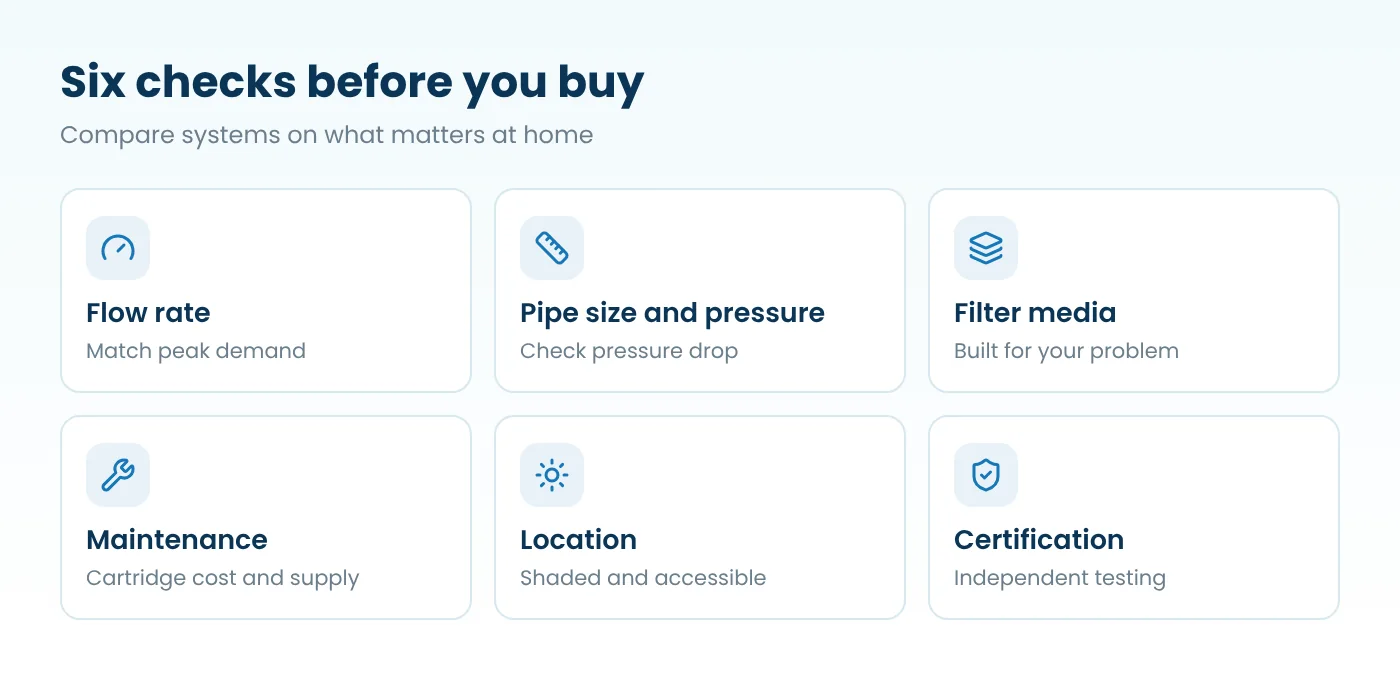
Flow rate
Filter capacity should match your peak demand, which is the amount of water you use when several outlets run at once. A system that is too small will reduce pressure in the shower. Bigger villas with more bathrooms need larger housings or more parallel capacity.
Pipe size and pressure
Confirm the pipe diameter and the available pressure. If the pressure is already low, ask about pressure drop across the filter and whether your booster pump can handle it.
Filter media
Carbon, sediment and specialist media all do different jobs. Ask which contaminants the system has been designed for, and look for independent certification where it is available.
Maintenance needs
Check how often cartridges need replacing, what they cost and how easily they can be obtained in the UAE. A cheap system can become expensive to run, and an unmaintained filter can cause more trouble than having none.
Available space
The system needs a shaded, accessible spot that is protected from the worst of the heat. Direct sun can damage plastic housings and encourage algae, so UV protection or a covered location matters in Dubai.
Villa vs apartment: what is different?
Villas
Villas usually offer the most straightforward installation, as the owner controls the tank and main line. The filter can sit near the tank or pump, with space for backwash or drain connections.
Apartments
Apartments are trickier. You do not control the building’s tank, and space near the main inlet to your unit may be limited. A compact system can sometimes fit inside a utility cupboard. Always get approval from the landlord or building management before changing the plumbing, and check who will be responsible for leaks.
If a full installation is not possible, shower filters and an under-sink filter give you many of the same benefits with no major changes.
What installation involves
A trained installer will isolate the water, connect the housing, fit bypass and isolation valves, check for leaks and flush the new media. A bypass valve is worth insisting on, as it allows you to keep water running during maintenance. Good installation also leaves room to change cartridges easily.
Ask for the commissioning details, so you have a record of the date, pressure readings and cartridge types.
How to maintain a whole house system
- Replace sediment cartridges on time. Dirty water may mean they need changing more often than the label suggests.
- Change carbon media as scheduled. Once it is exhausted, it stops doing its job.
- Watch for pressure drops. Falling pressure across the home is often the first sign of a blocked filter.
- Keep the housing shaded. Check it for cracks or algae.
- Keep your tank clean. Twice-yearly tank care helps your filters last longer.
- Book an annual service. A technician can inspect seals, valves and overall performance.
Frequently asked questions
Is water from a whole house filter safe to drink?
It is usually cleaner than unfiltered water, but most systems are designed for general household use. For drinking, an RO or dedicated drinking water filter is a better choice.
Will a whole house filter remove hard water scale?
Standard sediment and carbon filters do not prevent scale. You need a softener or a specific scale-control system for that.
Does a whole house filter reduce water pressure?
A correctly sized system should cause little noticeable drop. A big fall in pressure often means that the system is too small or the cartridge is blocked.
How long does a whole house filter last?
The housing can last for years, while cartridges and media are replaced according to the manufacturer’s schedule and the condition of your water.
Choose the system that matches your water
The best system is the one built around your actual problem. Clean the tank, identify the issue, and then size the filter to your home. If you are ready to compare complete home systems, browse our whole house water filters and softeners in Dubai.